Why LegalTech's £65 Billion Future Depends on Solving a Problem Nobody's Measuring
I've spent years watching law firms buy technology they never actually use. The pattern repeats itself with remarkable consistency.

I've spent years watching law firms buy technology they never actually use.
The pattern repeats itself with remarkable consistency. A firm announces its AI deployment. Press releases celebrate innovation. Partners attend launch events. Then six months later, I'm sitting in their offices diagnosing why adoption flatlined at 12%.
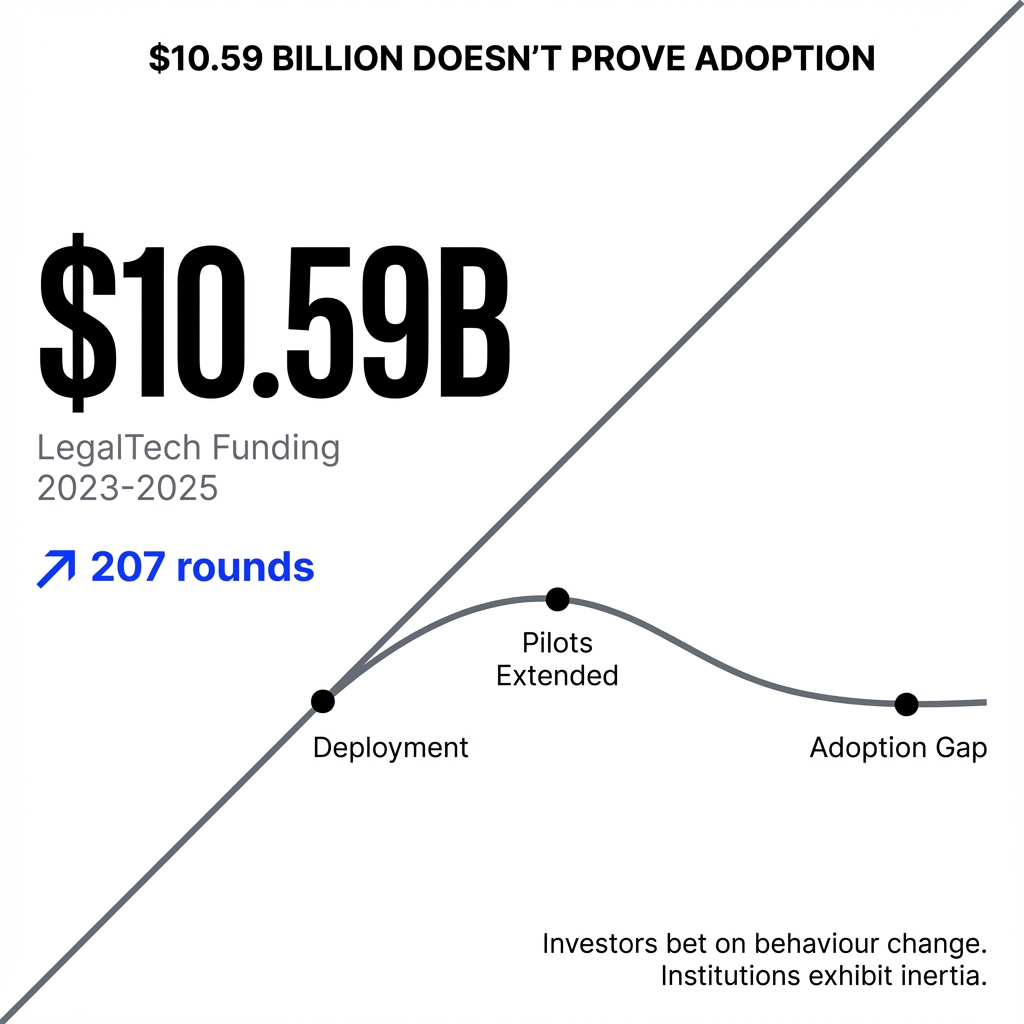
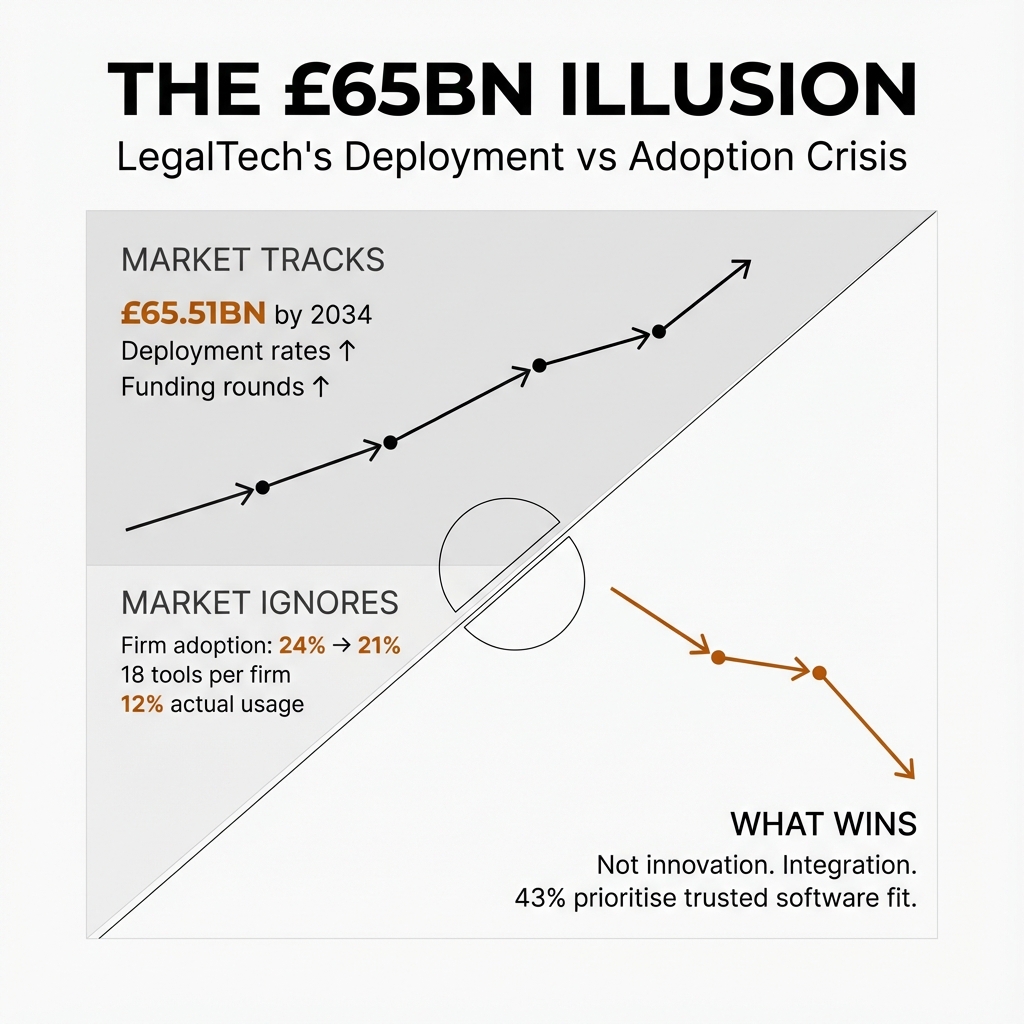
The LegalTech market will reach $65.51 billion by 2034. That's the projection everyone quotes. But I'm watching a different number—one that tells you whether any of that capital will actually deliver value.
The Measurement Gap That's Swallowing Billions
Here's what the market tracks: deployment rates, funding rounds, feature releases, market size projections.
Here's what the market ignores: whether anyone's actually using the bloody things after the implementation team leaves.
The data exposes this beautifully. 31% of legal professionals personally use generative AI at work. Sounds promising until you notice that firm-wide adoption dropped from 24% to 21% between 2023 and 2024.
Individual lawyers experiment. Institutions hesitate. The gap between personal tinkering and operational embedding isn't closing—it's widening.
This isn't a technical problem. It's a behavioural one that the industry keeps misdiagnosing as a technical challenge.
What Actually Determines Success (And It's Not What Vendors Sell)
I've watched this play out across dozens of implementations. The tools that succeed aren't the most sophisticated. They're the ones that create the least friction with existing workflows.
43% of firms prioritise integration with trusted software as their top investment criterion. Not innovation. Not capability. Integration.
Translation: firms want tools that fit into their Microsoft-centric operational habits, not ones that force them to rebuild their entire procedural infrastructure.
The legal aid sector proves this principle from the opposite direction. 74% of legal aid organisations already use AI—double the wider profession's 37% adoption rate. Why? Because they measure success by clients served, not technology deployed. Existential necessity forces genuine embedding.
When your funding depends on demonstrating impact, you don't have the luxury of treating deployment as the finish line.
The Fragmentation Crisis Nobody's Addressing
Large law firms now run an average of 18 different generative AI tools across practice groups.
Eighteen.
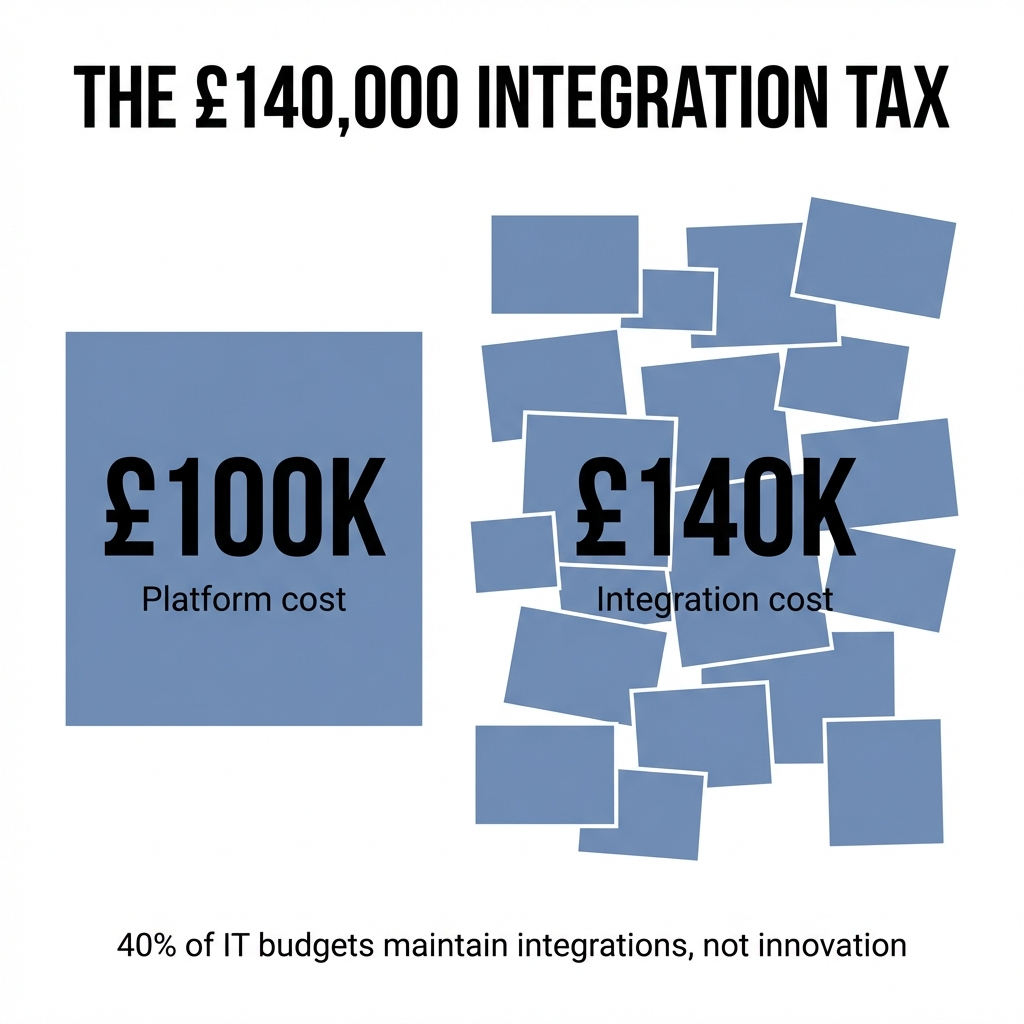
Each one purchased because it solved a specific problem. Each one creating data silos, inconsistent user experiences, security vulnerabilities, and budget bloat.
This is what happens when you optimise for acquisition rather than adoption. You accumulate capability without operational legibility. The technology stack becomes a monument to good intentions and poor integration.
The push towards platform consolidation isn't about vendor preference. It's about operational survival. You can't govern what you can't see, and you can't see across 18 disconnected tools.
What Changes When Governance Becomes Mandatory
The EU AI Act entered force on 1 August 2024. Full applicability arrives 2 August 2026. Prohibited practices and AI literacy obligations kick in from 2 February 2025.
This transforms AI from optional experiment to regulated operational reality.
UK firms maintaining cross-border operations face legally binding requirements based on risk tiers. Compliance isn't a checkbox exercise. It requires forensic understanding of how AI tools integrate with existing behavioural infrastructure—precisely the gap most firms haven't addressed.
Legal operations teams will become adoption guarantors by necessity, not choice. The question isn't whether to govern AI use. The question is whether your firm has the interpretive capacity to translate regulatory requirements into operational reality.
The Client Pressure That's Forcing the Issue
General Counsel are shifting their stance on AI. More significantly, 58% of in-house legal departments expect to rely less on outside law firms because of generative AI, compared to just 25% last year planning to reduce their law firm roster.
This isn't internal enthusiasm driving change. It's external market force.
When your clients demand AI fluency but your firm lacks adoption infrastructure, you face a credibility gap that no amount of deployment announcements will close.
The firms that will capture that budget allocation aren't the ones with the most tools. They're the ones who can demonstrate measurable adoption—actual usage patterns, productivity metrics, quality improvements.
Evidence, not promises.
What the Next 24 Months Will Actually Reward
Capital will concentrate at the extremes. Series C+ investment will increase. Seed-stage funding will contract. The market is moving past experimentation towards consolidation.
Vertical AI solutions that own industry-specific data and integrate into existing workflows will outperform horizontal platforms. Personal injury, class actions, contract lifecycle management—these aren't sexy, but they're embedded.
AI-native boutique firms will emerge as genuine competitors in specific practice areas. They won't carry the legacy infrastructure burden that slows adoption in traditional firms.
The $65 billion projection assumes the market solves its measurement problem. But if the industry continues treating deployment as success whilst ignoring adoption as the actual success criterion, that capital will chase diminishing returns.
I've watched this pattern long enough to know: the technology that wins isn't the most innovative. It's the most embedded.
The firms that thrive won't be the ones with the longest feature lists. They'll be the ones who cracked the code on behavioural integration—on making AI use feel like less work, not more.
That's the problem worth solving. Everything else is just expensive theatre.